How to Open Atividade (Início de Atividade) on Portal das Finanças
Before you can invoice as a freelancer or sole trader in Portugal, you have to "open activity" (abrir atividade) with the Autoridade Tributária. Here's the process, decision by decision.

- You must open atividade before invoicing more than once — a genuine one-off job (ato isolado) is treated differently.
- Two decisions up front: your CAE activity code, and Regime Simplificado vs Contabilidade Organizada.
- AT automatically notifies Segurança Social when you open activity; obtaining a NISS is a separate step if you do not already have one.
- It's free, and takes minutes online via the Portal das Finanças.
If you're going to do more than a single one-off job (an "ato isolado"), Portuguese law requires you to formally open activity (abrir atividade) with the Autoridade Tributária (AT) before you invoice anyone. It's the step that turns you into a registered self-employed worker — recibos verdes — for tax and Segurança Social purposes.
Two decisions to make first
The opening-activity form asks for two things you should decide before you start: your activity code, and your tax regime.
- CAE / código CIRS — the classification code for the work you'll actually invoice for. Look it up in SICAE (Sistema de Informação da Classificação Portuguesa de Atividades Económicas) or the AT's own FAQ on CAE/CIRS codes before you file.
- Tax regime — Regime Simplificado (taxable income is determined using statutory coefficients; no certified accountant is normally required) or Contabilidade Organizada (taxable business profit follows accounting rules and a certified accountant is required). At the start, projected Category B income above €200,000 means accounting; for an existing simplified-regime business, one year just above €200,000 does not by itself force an immediate switch.
The two regimes, side by side
Looking for company returns rather than personal Category B activity? See the Modelo 22 and IES guide.
| Regime Simplificado | Contabilidade Organizada | |
|---|---|---|
| Who it's for | Most freelancers starting out | At the start: projected income over €200,000; later: Article 28 exit conditions, or anyone who opts in |
| How tax is calculated | A fixed coefficient × your turnover, not your real expenses | Your real profit (revenue minus real deductible costs) |
| Accountant required? | No | Yes — a certified accountant (contabilista certificado) files for you |
| Who files the opening-activity form | You | Your accountant, on your behalf |
How to open activity
These online steps cover an individual without organised accounting; otherwise a certified accountant must file for you. Start at the official ATividade service. The AT submission FAQ explains the questionnaire and review. Finanças counters and relevant Citizen Shops are the in-person alternatives.
- Open the official ATividade service
Sign in to Portal das Finanças and follow ATividade > Submeter declarações to start the início de atividade declaration. Use the official service, not a paid registration intermediary.
- Have your activity details ready
Prepare the relevant CAE or CIRS code, estimated turnover until the end of the calendar year, and an IBAN/BIC for an account in your name. Use the preparation section above rather than guessing those answers inside the form.
- Complete the questionnaire using its help
For an individual without organised accounting, AT uses a questionnaire with contextual help and examples. Read the guidance when an answer is unclear; do not copy somebody else's settings.
- Review the details and the IRS/IVA treatment
Some information and tax treatment are inferred from your answers. Check both the supplied and inferred data, including the proposed IRS and IVA regimes, before submitting. If they do not reflect your circumstances, resolve that first.
- Submit, retain confirmation and check the registered activity
Submit only after the review; a saved draft is not a filing. Keep the submission acknowledgement provided by the portal. Afterwards consult ATividade > Consultar dados de Atividade > Situação Fiscal Integrada > Informação Cadastral > Atividade Exercida and compare the registered details with your declaration.
What happens immediately after opening
You can check what the AT registered under ATividade > Consultar dados de Atividade > Situação Fiscal Integrada, in the cadastral information under «Atividade Exercida». From your declaration the AT places you in an IRS regime by your estimated annual Category B income, the Regime Simplificado at €200,000 or less unless you opt for organised accounting, and in one of the IVA regimes it lists. Start issuing every invoice or fatura-recibo through the Portal das Finanças or the ATGO app before you are paid. Your Social Security enrolment as an independent worker takes effect on the first day of the 12th month after the month you started (art. 145.º of the Código Contributivo), which our guide to how contributions are calculated explains, and the January confirmation of your income still applies. If your activity changes later, the AT treats it as a declaração de alterações.
- When you open activity at the AT, Segurança Social is notified automatically. If you do not yet have a NISS, obtaining one is a separate identification step.
- Work-accident insurance is mandatory for self-employed workers (Decreto-Lei 159/99), with no part-time exception and also when you are employed at the same time — it covers accidents during work or your commute. The only exemption is production solely for your own or your household's use.
Not sure your setup is correct? Run the Recibos Verdes readiness check.
Check my freelancer setupIf you're a foreigner working for yourself in Portugal
The general steps above apply to everyone, but what you need before you get there depends on your nationality.
- EU, EEA, and Swiss citizens: no visa or work permit needed. You just need a NIF (tax number), then you open activity, then you register with Segurança Social to get a NISS.
- Third-country citizens: you need a visa or residence authorisation for self-employed work first — typically a D2 visa (for entrepreneurs and independent workers) or a residence permit for independent activity, based on evidence of economic activity in Portugal. Once you have that, the steps are the same: NIF, open activity, NISS.
If you still need a NIF, our guide to getting a NIF in Portugal has the full document checklist; the NISS is a separate application to Segurança Social with its own evidence list.
Before you file: the three things it asks for
The declaration itself takes minutes, but it wants three decisions you cannot change casually afterwards, so it is worth having them ready:
- Your activity code — either from the art. 151.º CIRS professional table or a CAE code. This drives your Regime Simplificado coefficient, so picking the wrong one changes what you are taxed on.
- Estimated turnover to the END of the current year — not a full twelve months. Open in October and you are estimating a quarter, which is what the €15,000 VAT threshold is measured against for that first year.
- An IBAN and BIC in your own name, to attach to the activity.
The one case where you don't file at all
If you're invoicing once — a single piece of work, not a continuing activity — that's an ato isolado, and you are exempt from filing an início de atividade declaration for VAT purposes regardless of the amount. You still declare the income on your IRS return. People routinely open activity, invoice once, and then have to close it again; if it genuinely is a one-off, you never needed to.
One subtlety worth knowing: an ato isolado's value is not counted in your estimated turnover for the year you start an activity, but it does count towards the prior-year figure when a VAT regime depends on it.
The VAT decision, and the trap for non-residents
The art. 53.º exemption is what most new freelancers want — no VAT charged, no periodic declarations. For someone established here it applies only if all of these hold: you have your seat or domicile in Portugal, you do not carry out exports or related activities, and your estimated turnover to the end of the starting year is €15,000 or less (art. 53.º n.os 1 and 5 CIVA).
Read the first condition carefully if you are new here. Without domicile or a seat in Portugal, the art. 53.º exemption is only open to someone established in another EU Member State, through the EU cross-border scheme: EU-wide turnover of no more than €100,000, prior notification to your home Member State, and an identification number with the suffix 'EX' issued there (art. 53.º n.º 2 CIVA, in the wording of Decreto-Lei 35/2025). Someone established outside the EU has no such route. Arriving mid-year and opening activity before your residency is settled can therefore land you in the normal VAT regime from day one.
For an existing exempt activity, ending the year above €15,000 normally moves you to the standard VAT regime on 1 January of the next year, with a change declaration due within 15 working days after year-end. But if current-year turnover passes €18,750, the exemption ends immediately: the operation that crosses €18,750 is already subject to IVA, and the change declaration is due within 15 working days. Periodic returns are generally quarterly below €650,000 of prior-year turnover and monthly at or above that amount; the return is due by day 20 of the second month after the period and payment by day 25.
Who withholds tax from your invoices
A payer that has or must have organised accounting generally withholds IRS when paying qualifying Category B income. The current rates are 23% for professional activities specifically listed under Article 151, 11.5% for the other Category B service income covered by Article 101, and 16.5% for the specified intellectual or industrial property income. The withholding is applied to the gross amount before IVA and is a payment on account of the final annual IRS bill.
The Article 101-B withholding waiver is optional. It can generally be used when you expect annual Category B income below €15,000, but not if prior-year income was already €15,000 or more. If you reach €15,000 during the year, the waiver ends in the following month. Being paid without withholding does not make the income tax-free; the final amount is settled through the annual IRS assessment and, where applicable, payments on account.
What you're signed up to afterwards
Opening activity is the start of three recurring duties, each with its own guide: issuing recibos verdes and the Categoria B tax that follows them, IVA for freelancers once you are outside the art. 53.º exemption, and the quarterly Segurança Social declaration. In detail:
- Issue every invoice or fatura-recibo through the Portal das Finanças system or the ATGO app. Doing so exempts you from separately reporting your invoices by the 5th of the following month.
- Without organised accounting, classify your invoices under Serviços – IVA > Classificação de Documentos, separating sales, business expenses and investment goods.
- On the normal VAT regime, a periodic declaration each quarter, plus a recapitulative declaration whenever you invoice businesses in other EU states.
- Quarterly Social Security declarations, and three IRS payments on account if your prior-year figures trigger them.
Changing or closing it
Both have deadlines people miss. A declaração de alterações is due within 15 days of anything on your registration changing — address, activity code, regime, bank account (art. 112.º n.º 2 CIRS). A declaração de cessação is due within 30 days of actually stopping (n.º 3).
Two things worth knowing about the regime itself. If you are in organised accounting because it was legally required and the previous year's Category B income is €200,000 or less, AT moves you to Regime Simplificado unless you opt to remain in accounting by the end of March. In the other direction, Regime Simplificado ends only after income exceeds €200,000 in two consecutive tax years or exceeds €250,000 in a single tax year; organised accounting then starts in the following tax year. Switching activity is a registration change, not a cessation followed by a fresh start. For how the simplified regime taxes you, see thesimplified regime guide.
Keeping your registration current
Keep registered details such as your address, activity code and bank information current; Article 112 CIRS generally gives 15 days for a declaration of changes. Do not treat a single crossing of €200,000 as an immediate switch to organised accounting: the separate Article 28 tests above govern that transition, and any mandatory change takes effect in the following tax year.
Frequently asked questions
How do I check that my activity registration was submitted?
A saved draft is not a submitted declaration. Retain the portal's submission acknowledgement, then consult ATividade > Consultar dados de Atividade > Situação Fiscal Integrada > Informação Cadastral > Atividade Exercida to check the recorded details. Ask AT if the outcome is unclear.
What if the portal only offers Alteração or Cessação de Atividade?
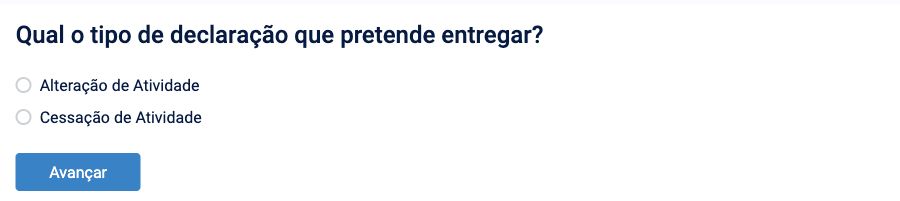
Check your registered activity before choosing another declaration. Alteração changes a registration; Cessação closes it. Do not choose cessation simply to reach an opening form. If you cannot identify the right request for your situation, ask AT or your certified accountant.
Does opening activity cost anything?
No — filing the declaração de início de atividade is free, whether you do it online or in person.
Do I need to open activity for a single one-off job?
If it's genuinely a one-time job (an ato isolado), Portuguese rules treat it differently from ongoing self-employment. If you expect more than one invoice, open activity instead.
Do I need an accountant to open activity?
Not under Regime Simplificado — you file it yourself. Under Contabilidade Organizada, your certified accountant handles the opening-activity filing as part of onboarding you.
What happens if my turnover changes after I've opened activity?
Update changed registration details within the applicable deadline, generally 15 days. Turnover has separate rules: Simplificado ends only after income exceeds €200,000 in two consecutive years or €250,000 in one year, with organised accounting starting in the following tax year.
Get the free Portugal tax playbook
A first-year PDF: NIF and NISS, NHR vs IFICI vs IRS Jovem, the Modelo 3 annex map and the deadline calendar. Sent to your inbox.