CAE Codes in Portugal: How to Choose the Right Activity Code
Two official lists can describe what you do. The activity you declare feeds your IRS coefficient and can change your Social Security rate, so choose by the work you actually do.

- Art. 151.º CIRS classifies an IRS taxpayer's activity by the CAE or by the codes in a ministerial table (Portaria 1011/2001). They are alternatives, not two steps.
- CAE-Rev.4 has applied since 1 January 2025 (Decreto-Lei 9/2025) and replaced Rev.3. Some AT help pages still say Rev.3, so check the current code before you file.
- The nature of your income sets your IRS coefficient (art. 31.º): 0.75 for professions specifically listed in the art. 151.º table, 0.35 for other services, 0.15 for sales of goods.
- It also sets your Social Security rate: 21.4% for services, 25.2% for sole traders with commercial or industrial income.
- The code alone does not decide VAT: turnover and the exemption rules do. Some professions, such as doctors and psychologists, are exempt by nature (art. 9.º CIVA).
When you open atividade, the AT asks for the code of the activity you will carry out. You can take it from the CAE, the national classification (now Revisão 4), or from the profession table behind art. 151.º of the IRS Code. This applies if you will invoice as a sole trader or freelancer. Next: write down what a client actually pays you for, find it in both lists, and declare the code that fits. It is not a formality, because the activity feeds your IRS coefficient and can change your Social Security rate.
Two lists, one purpose
Art. 151.º CIRS is one sentence long: the activities of IRS taxpayers are classified, for IRS purposes, according to the CAE of the Instituto Nacional de Estatística, or according to the codes in a table of activities approved by ministerial order. The AT's leaflet on starting an activity names that table: Portaria n.º 1011/2001, of 21 August. So the CAE and the art. 151.º table are two ways of naming the same thing. The pack of advice you may have read that treats CAE as the list for businesses and the CIRS table as the list for professions is not what the law says.
The AT's start-of-activity page adds a third list to the questionnaire: «atividades de elevado valor acrescentado». That is the list behind the high-value-added incentive regimes, which our NHR and IFICI guide covers. If you are not claiming one of those regimes, it is not your list.
One rule from the AT's own FAQ is worth knowing: a company can have only a CAE code, never a CIRS code. Individuals with professional income who take up a different activity from the one they declared must change their CIRS code. The AT leaflet adds the mechanism. Moving to a different activity is a declaração de alterações, not a cessation.
CAE Rev.4: what changed
Decreto-Lei n.º 9/2025, of 12 February, establishes CAE-Rev.4. Its art. 8.º says it takes effect on 1 January 2025, and its art. 7.º repeals Decreto-Lei 381/2007, the diploma behind Rev.3. Under art. 2.º the code you declare is the fifth level, a five-digit subclass. INE manages the classification and publishes equivalence tables between Rev.3 and Rev.4 (arts. 4.º and 5.º). The AT's own leaflet now names CAE-Rev.4 as the list to use.
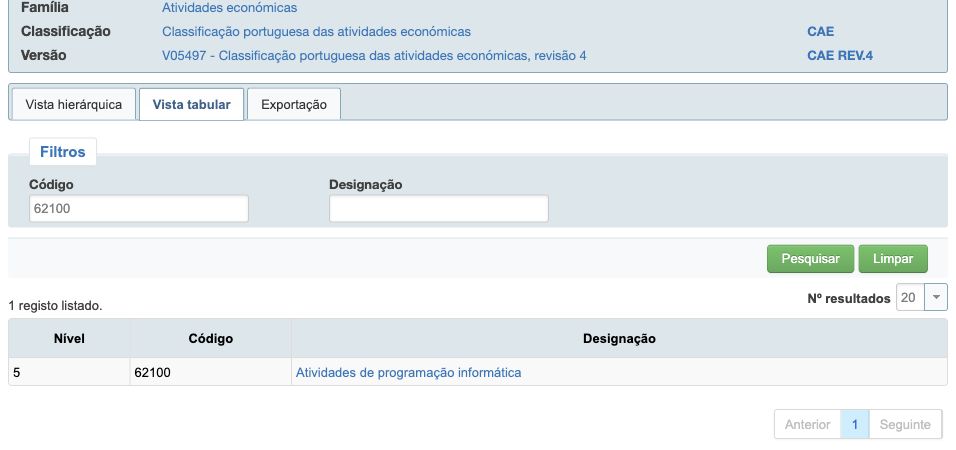
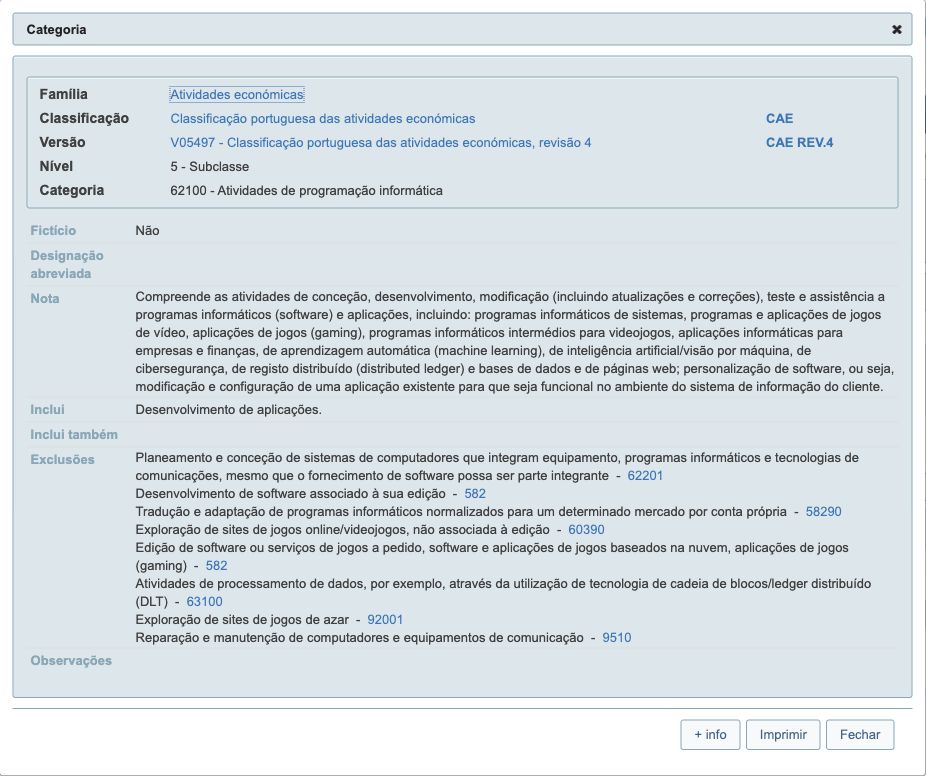
Why it matters in practice: numbers moved and meanings moved. In the Rev.4 annex, programação informática is 62100 and consultoria em informática is 62201, while 47910 is now «atividades de serviços de intermediação no comércio a retalho não especializado». A code copied from a blog post or an old invoice written before 2025 has to be checked against the current list, not assumed. Some AT help pages, such as the CAE FAQ, still say Rev.3, so do not treat a page's silence as confirmation.
How to choose the code
- Write down what the client pays you for
«Digital services» is too vague. «UX design for a client's software product» or «online language tutoring» is specific enough to search for.
- Check the art. 151.º table for a listed profession
The 0.75 coefficient applies to activities «specifically provided for» in that table, so it matters whether your work is actually listed there, not what the label sounds like.
- Search the current CAE Rev.4 descriptions
Use INE's classification search and read the full Rev.4 subclass notes, including exclusions, not only its title. Check an older code against the equivalence tables before using it.
- Declare every activity you will really carry out
The AT asks for the «código(s) de atividade». If you will do genuinely different work, declare each. Do not add codes «just in case».
- Check the consequences separately
IRS, Social Security and VAT each follow their own rules. The next section shows what the activity does and does not decide.
Teachers and tutors: which CIRS code?
If you personally teach or tutor as a self-employed professional, start with the named professions in the official article 151 table. These are four-digit CIRS codes, not five-digit CAE codes:
| CIRS code | Official designation | English meaning |
|---|---|---|
| 8010 | Explicadores | Tutors |
| 8011 | Formadores | Trainers |
| 8012 | Professores | Teachers |
| 8013 | Professores ou educadores artísticos | Arts teachers or educators |
Example: describe private maths tutoring as tutoring, not simply ‘education’. Running a school or training business needs its own activity analysis; do not apply a personal teaching code to a company, which can only register CAE codes. If the description overlaps, ask INE about the CAE classification and AT about the tax registration.
Is 1519 a CAE code, and does it mean less tax?
1519 is the CIRS entry ‘Outros prestadores de serviços’, not a CAE subclass. It does not itself name a specific profession. AT Circular 2/2016, points 4–5 explains the distinction; the current article 31 still separates specifically listed professional services (0.75) from other services (0.35). Registering 1519 does not turn teaching, programming or another specifically listed profession into an unlisted service. Classify the real work first; do not select the label to obtain a coefficient.
Look up, check or change a code
- Choosing a new CAE? Follow INE's official lookup instructions: SMI → Classificações → Versões → search ‘CAE Rev.4’. Read the explanatory notes and exclusions; use ‘Correspondência de versões’ to compare an old code.
- Checking what you already registered? The AT FAQ 4405 points to ‘Posição Integrada’ on Portal das Finanças. SICAE is the public company/equivalent-entity register, not a complete directory of individuals' CIRS codes.
- Adding or changing an individual's activity? Use ATividade → Submeter declarações → Alteração de Atividade, not a new initial declaration. Review the codes and effective dates, submit only once correct and recheck the registered activity afterwards. A saved draft is not a submitted amendment. Companies may first need an IRN change if the new activity is outside their corporate object.
- Preparing the declaration? Use the activity-registration walkthrough; the finder suggests candidates but does not register or change anything for you.
What your activity decides
IRS. Under the simplified regime, taxable income is your turnover times a coefficient set by art. 31.º n.º 1 CIRS:
| Type of income | Coefficient | Provision |
|---|---|---|
| Professions specifically listed in the art. 151.º table | 0.75 | art. 31.º n.º 1 b) |
| Other service income | 0.35 | art. 31.º n.º 1 c) |
| Sales of goods, crypto-asset operations, restaurant and hotel services | 0.15 | art. 31.º n.º 1 a) |
Example: €20,000 of service income in a normal year gives €15,000 of taxable income at 0.75 and €7,000 at 0.35, before the deductions and expense check in art. 31.º n.os 2 and 13. The gap is the reason to declare what you actually do, and the law asks about the activity, not the label on it. In the year you start and the next, the 0.75 and 0.35 coefficients are cut by 50% and 25%, so 0.375 and 0.5625 for a listed profession, as long as you have no employment or pension income in those years and did not close another activity less than five years ago (art. 31.º n.os 10 and 11). The 0.15 coefficient is not reduced.
Social Security. Sole traders with commercial or industrial income under art. 3.º n.º 1 a) CIRS are «empresários em nome individual» (art. 134.º n.º 1 b) of the Código Contributivo) and pay 25.2%. Workers providing services under art. 3.º n.º 1 b) pay 21.4% (art. 168.º n.os 1 and 4). So an activity registered on the commerce side changes the rate, and our guide to how contributions are calculated explains the rest of the maths.
VAT. The AT frames you in an IVA regime from what the declaration says, including your estimated turnover, not from the code alone. Some professions are exempt by their nature: art. 9.º CIVA exempts services by doctors, dentists, psychologists, nurses and paramedical professions. For everyone else the exemption turns on turnover and conditions, which our IVA guide for freelancers and the IVA threshold checker cover.
Describe what you do in the CAE Finder and read the Rev.4 description of each match before you declare it.
Find my CAE codeWhat to have ready before you file
- The code or codes of the activity you will carry out, from the art. 151.º list or the CAE-Rev.4.
- Your estimated turnover for the rest of the current year, not for twelve months. If you will also do VAT-exempt work under art. 9.º, count only the taxable part.
- An IBAN and BIC/SWIFT for a bank account in your own name.
- If you are a comerciante em nome individual, your registration at the Conservatória: the declaration is due within 15 days of it, and always before you start.
Common mistakes
- Using a pre-2025 code without checking it against Rev.4. The same number can now describe something else.
- Choosing a code for the coefficient it seems to give. The law asks whether the activity is specifically listed, so the real work is what counts.
- Not filing a declaração de alterações when the activity changes. The AT treats a switch to a different activity as an amendment, not a closure.
- Assuming the code does not matter for Social Security. Commercial and service activities sit on different rates.
- Copying another freelancer's code when your service is different.
Frequently asked questions
Which activity code should a teacher or private tutor use?
Check the CIRS profession first: 8010 Explicadores, 8011 Formadores, 8012 Professores or 8013 Professores ou educadores artísticos. Choose the description matching the work, not the lowest tax result. These are personal professional codes; a company needs a CAE classification instead.
Is 1519 a CAE code for other service providers?
No: 1519 is a CIRS code, ‘Outros prestadores de serviços’. It is not a five-digit CAE code or a way to avoid the coefficient for a specifically listed profession. AT distinguishes unlisted services from named professions by the actual activity, not just the registered label.
Where can I check my registered activity code?
AT's FAQ directs you to Posição Integrada on Portal das Finanças. SICAE provides public CAE information for companies and equivalent entities; do not expect it to show every individual professional's CIRS record. For choosing a CAE, use INE's current Rev.4 descriptions and notes instead of treating a register search as classification advice.
What is the difference between a CAE code and a CIRS code?
Both classify your activity for IRS. Art. 151.º CIRS allows either the CAE from INE or the codes in the table approved by Portaria 1011/2001. The table matters because the 0.75 coefficient applies to professions specifically listed in it.
Can a company have a CIRS code?
No. According to the AT's FAQ, companies and equivalent entities can only have CAE codes.
Does my CAE code decide whether I charge VAT?
Not on its own. Your IVA regime follows from the declaration, including turnover, and from the exemption rules. Some professions, such as doctors and psychologists, are exempt by nature under art. 9.º CIVA.
Does my activity code affect my Social Security contributions?
It can. Sole traders with commercial or industrial income pay 25.2%, while workers providing services pay 21.4% (Código Contributivo, arts. 134.º and 168.º).
How do I change my activity code after opening atividade?
For an individual, use ATividade → Submeter declarações on Portal das Finanças and select Alteração de Atividade. Review the code and effective date, submit the amendment and check the resulting registered details. Do not close and reopen the activity just to add another code. Companies may need an IRN change first if the new activity is outside their corporate object; deadlines depend on the change.
Get the free Portugal tax playbook
A first-year PDF: NIF and NISS, NHR vs IFICI vs IRS Jovem, the Modelo 3 annex map and the deadline calendar. Sent to your inbox.