IUC in Portugal: Who Pays the Annual Vehicle Tax, How Much, and When
The annual tax on owning a car, motorcycle, lorry, boat or plane registered in Portugal, and the calendar that changes in 2027.

- IUC is owed by whoever the vehicle is registered to, every year, whether or not the vehicle is used.
- Up to 2026 it is due by the end of the month your Portuguese registration has its anniversary; there is no bill, you issue it yourself.
- For cars first registered from July 2007 the amount comes from engine size and CO2, times a coefficient for the registration year, plus a surcharge for diesel.
- Fully electric vehicles are exempt; so are taxis and TVDE cars within a CO2 limit, and one vehicle per year for a person with a disability of 60% or more, up to €240.
- From 2027 the tax covers the calendar year and one annual bill per person covers every vehicle: in 2027 it is paid in October (or in July and October when the total is above €500), and from 2028 from April.
IUC (Imposto Único de Circulação) is the annual tax on owning a vehicle registered in Portugal. It is not a road toll and it does not depend on how much you drive: the registration certificate decides who pays and the vehicle's data decides how much. This guide covers the rules for 2026, which are the ones the law applies until 31 December, and the new calendar that Decree-Law 161/2026 brings in from 2027.
Who pays IUC
After buying or selling, check the vehicle ownership-transfer guide rather than treating the tax payment as proof of registration. Permission to drive is separate too: use the Portuguese licence-renewal guide to check your own deadline.
The taxpayer is the person or company in whose name the vehicle's ownership is registered (CIUC art. 3.º). Someone with a vehicle on financial lease, a buyer under a retention-of-title contract and anyone holding a purchase option under a lease is treated as the owner. An undivided estate pays through its administrator (cabeça de casal).
Because the register decides, selling a car without registering the sale leaves the tax with the seller. There is a narrow way back: when the sale was verbal and the seller asks for the ownership to be registered within one year after the deadline the buyer missed, IUC follows the date of the sale (art. 17.º-A).
IUC is also owed on a vehicle that is not registered in Portugal but stays here for more than 183 days in a calendar year, counted together or apart, except goods vehicles of 12 tonnes or more (art. 2.º n.º 2). That is the rule that catches residents who keep driving a car on foreign plates.
The seven categories
- Category A: passenger cars and light mixed-use vehicles up to 2,500 kg first registered in Portugal or another EU or EEA state from 1981 until 30 June 2007.
- Category B: the same vehicles first registered in Portugal or the EU/EEA from 1 July 2007, the day the code came into force. Most cars on the road today are B.
- Categories C and D: goods and mixed-use vehicles over 2,500 kg, C for own-account transport and D for hire or reward.
- Category E: motorcycles, mopeds, tricycles and quadricycles registered since 1992.
- Category F: private recreational boats of 20 kW or more registered since 1986. Category G: private aircraft.
The date that decides between A and B is the first registration anywhere in the EU or EEA, not the date the car arrived in Portugal. A German car first registered in 2005 and imported in 2024 is category A.
How the amount is worked out for a category B car
Two components are added: one for the engine size and one for the CO2 figure. The CO2 bands differ by the test cycle printed on the registration: older cars were measured under NEDC and newer ones under WLTP, which reads higher for the same car, so the WLTP bands start higher. The sum is multiplied by a coefficient for the year of first registration: 1.00 for 2007, 1.05 for 2008, 1.10 for 2009 and 1.15 for 2010 and later.
| Engine size | Rate | CO2 NEDC | CO2 WLTP | Rate |
|---|---|---|---|---|
| up to 1250 cm³ | €31.77 | up to 120 g/km | up to 140 g/km | €65.15 |
| 1251–1750 cm³ | €63.74 | 121–180 g/km | 141–205 g/km | €97.63 |
| 1751–2500 cm³ | €127.35 | 181–250 g/km | 206–260 g/km | €212.04 |
| over 2500 cm³ | €435.84 | over 250 g/km | over 260 g/km | €363.25 |
Cars first registered after 1 January 2017 with high emissions pay an extra CO2 rate on top (art. 10.º n.º 2). Diesel cars pay a separate surcharge set by the 2015 budget law and kept in force for 2026; it is added after the coefficient, not multiplied by it.
| Engine size | Diesel surcharge |
|---|---|
| up to 1250 cm³ | €5.02 |
| 1251–1750 cm³ | €10.07 |
| 1751–2500 cm³ | €20.12 |
| over 2500 cm³ | €68.85 |
A worked example. A diesel car first registered in 2019, with a 1,598 cm³ engine and 130 g/km under WLTP, pays €63.74 for the engine and €65.15 for CO2, €128.89 together. Times the 1.15 coefficient and plus the €10.07 diesel surcharge, the 2026 IUC is €158.29.
Enter your vehicle's registration date, engine and CO2 to see each part of the 2026 amount, for every category from A to G.
Work out my IUCCategory A and the other categories
Category A cars pay a fixed amount that depends on the fuel, the engine size and which of three registration periods the car falls in (after 1995, 1990 to 1995, 1981 to 1989). There is no CO2 component, which is why an older car can cost much less than a newer one with the same engine. Diesel A cars also pay the diesel surcharge.
Lorries and vans over 2,500 kg (C and D) are taxed on gross weight, number of axles, suspension type and age; for 12 tonnes and above the law prints a table for each axle count. Motorcycles (E) pay by engine size and registration period. Boats pay per kW and aircraft per kilogram of maximum take-off weight, with a ceiling. The calculator covers all of them.
When to pay in 2026
In the year a vehicle is first registered in Portugal, IUC must be issued within 30 days after the deadline for registering it (art. 17.º n.º 1). After that, for categories A to E, the tax year starts on each anniversary of the registration and the tax is due by the end of that month (arts. 4.º and 17.º n.º 2). A car registered in Portugal on 14 May pays by 31 May every year. For an imported car the month is the month of the Portuguese registration.
Boats and aircraft follow the calendar year, so their IUC falls due in January. Our tax calendar guide lists IUC next to the other yearly deadlines, and a signed-in calendar places the IUC date for each vehicle you save.
- Know your vehicle's category and data
Your registration certificate (Documento Único Automóvel) gives the date of first registration, the engine size, the fuel and, for cars registered from July 2007, the CO2 figure and the test cycle it was measured under.
- Find your month
Up to and including 2026, IUC for a car, van, lorry or motorcycle is due by the end of the month in which its Portuguese registration has its anniversary. Boats and aircraft follow the calendar year.
- Issue the payment on the Portal das Finanças
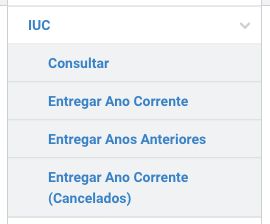
In 2026 AT does not send a bill. You issue the tax yourself on the Portal das Finanças (the law calls this the liquidação), which produces a DUC payment reference.
- Pay the DUC reference
Pay the reference before the end of the month through the payment network, for example Multibanco or your bank's online banking. Keep the receipt: it is the proof of payment.
Amounts under €10 are not charged. If the Portal does not list your vehicle or its data are wrong, the tax can be issued at a tax office instead. The Portal das Finanças guide explains signing in.
Exemptions
- Vehicles that are fully electric or run on non-combustible renewable energy, and non-motorised vehicles, ambulances, hearses and agricultural tractors (art. 5.º n.º 1 e).
- Category B cars up to 180 g/km (NEDC) or 205 g/km (WLTP), and category A cars, used as taxis or for TVDE ride-hailing, marked with the letter T (art. 5.º n.º 1 f).
- Cars over 30 years old recognised as of historic interest, used only occasionally and for no more than 500 km a year, in categories A, C, D and E (art. 5.º n.º 1 d). Category B is not on the list.
- A person with a disability of 60% or more, for one vehicle a year, up to €240.00: a category B car within the same CO2 limits, or a category A or E vehicle. It is recognised at a tax office, or online when the disability is already on AT's records (art. 5.º n.º 2 a and n.º 5).
- Private social solidarity institutions (IPSS), recognised by their tax office, and half the tax for C and D vehicles that only operate inside the Azores or Madeira.
What happens if you do not pay
Not paying is an offence punished with a fine under article 114 of the General Regime of Tax Offences (art. 21.º). An officer who finds it can seize or immobilise the vehicle and its documents until the tax is paid, and the State has a special claim over the vehicle for the tax and the fine (art. 22.º). The tax and the fine can be paid on the spot, against a provisional receipt (art. 23.º).
What changes from 2027
Decree-Law 161/2026 of 4 August takes effect on 1 January 2027 and changes the calendar, not the rates. The tax year becomes the calendar year; in the year of registration it runs from the registration date to 31 December, and the tax is reduced in proportion to the full months already gone. AT issues one annual assessment per taxpayer covering every vehicle registered to them on 1 January, which the taxpayer obtains on the Portal.
- 2027 only: one payment in October when your total for the year is €500 or less; two, in July and October, above that.
- From 2028: one payment in April up to €100; April and October from €100 to €500; April, July and October above €500. You can always pay everything in April.
- The band is your total across all your vehicles, not one car's bill, and missing an instalment makes the rest due at once.
Frequently asked questions
Do I still pay IUC if my car is off the road?
Yes. IUC is owed for as long as the vehicle is registered, and it stops only when the registration is cancelled because the vehicle was scrapped under the law. Not using the car does not stop it.
Does AT send me an IUC bill?
Not in 2026. You issue it yourself on the Portal das Finanças by the end of your registration month. From 2027 AT prepares one annual assessment per taxpayer, and you obtain it on the Portal.
My car was imported. Which month do I use?
Up to 2026, the month of the Portuguese registration. The date of first registration in another EU country still decides the category and the coefficient, but not the month.
Is an electric car exempt?
A fully electric car is exempt (art. 5.º n.º 1 e). A plug-in hybrid is not: it has a combustion engine and pays on engine size and CO2 like any other car.
I sold my car but I got an IUC reminder. Why?
The tax follows the registered owner. If the sale was never registered, it is still your car for IUC. Register the transfer; if the sale was verbal, a request by the seller within one year of the buyer's deadline makes IUC follow the date of the sale.
Get the free Portugal tax playbook
A first-year PDF: NIF and NISS, NHR vs IFICI vs IRS Jovem, the Modelo 3 annex map and the deadline calendar. Sent to your inbox.